
A microduct may look like a simple polymer tube, yet small variations in its internal diameter can affect fiber installation, pulling resistance, and network deployment efficiency. At production speeds exceeding 80 m/min, even minor fluctuations in melt delivery or cooling conditions can accumulate into measurable dimensional deviations.
A plastic extruder must maintain a stable relationship between material flow, die geometry, and haul-off speed to produce a uniform bore over long manufacturing runs. In telecommunications infrastructure, dimensional control is not merely a cosmetic concern; it influences how reliably optical fiber can pass through the duct.
Melt Pressure Stability and Material Flow
Melt pressure provides an important indication of how consistently polymer moves through the extrusion system. Pressure fluctuations can result from inconsistent feed rates, temperature variation, changes in resin properties, or restrictions within the flow channel. As pressure changes, the volume and velocity of material leaving the die may shift, affecting both wall thickness and the internal passage of the finished microduct.
HDPE introduces specific process considerations because its viscosity responds to temperature and shear conditions. If the melt becomes too viscous, pressure demand may rise and flow distribution can become less uniform. Excessive temperature, however, may affect dimensional stability and increase the risk of material degradation during extended production. A properly configured plastic extruder requires coordinated temperature regulation across the barrel, adapter, and die rather than relying on a single temperature reading.
Pressure monitoring becomes particularly valuable during speed increases. An operator can compare pressure trends with screw speed, output rate, and downstream measurements to distinguish a temporary disturbance from a persistent process problem. Stable pressure does not independently prove that the bore is correct, but it provides an essential process signal when diagnosing dimensional variation. Alarm limits and trend records also help production teams identify changes before large quantities of out-of-specification duct accumulate.
Gravimetric Dosing and Output Consistency
Accurate material feeding establishes the foundation for dimensional control. Gravimetric dosing systems measure material consumption by weight over time, allowing the control system to regulate feed according to a target mass flow rather than relying exclusively on volumetric estimates. This distinction matters when pellet bulk density varies or material feeding becomes less predictable during continuous high-speed operation.
The relationship between mass throughput and line speed is especially important for microducts. If the haul-off accelerates while material output remains unchanged, the extruded tube may become thinner. If output rises disproportionately, wall thickness can increase and reduce the available internal passage. A pipe extrusion machine must coordinate throughput with haul-off speed so that the material deposited per unit length remains consistent with the intended geometry.
Gravimetric control also helps reveal whether apparent dimensional problems originate upstream. Suppose the bore gradually narrows while the line speed remains constant. Feed records can show whether polymer consumption has increased, while pressure data may indicate a corresponding change in melt delivery. This combined evidence is more useful than adjusting the die immediately, since mechanical corrections cannot reliably compensate for an unstable material supply. Regular feeder calibration, consistent pellet handling, and appropriate control-loop tuning further support repeatable output.
Die Design and Internal Bore Geometry
The die head determines how molten HDPE is distributed around the forming passage before the duct enters calibration and cooling equipment. Uneven flow around the circumference can produce eccentric walls, while an unsuitable mandrel profile or flow-channel finish may create localized resistance. At high throughput, these effects become more difficult to manage because the material has less time to stabilize before downstream sizing begins.
For microduct production, the mandrel and die opening must be designed around the target outside diameter, wall thickness, and internal bore. Melt swell, die pressure, resin rheology, and drawdown all influence the dimensions that emerge from the tooling. A plastic extruder with sufficient output capacity may still produce inconsistent duct if the die geometry does not match the material and operating window. Tooling design and process settings must function as one system rather than as separate purchasing decisions.
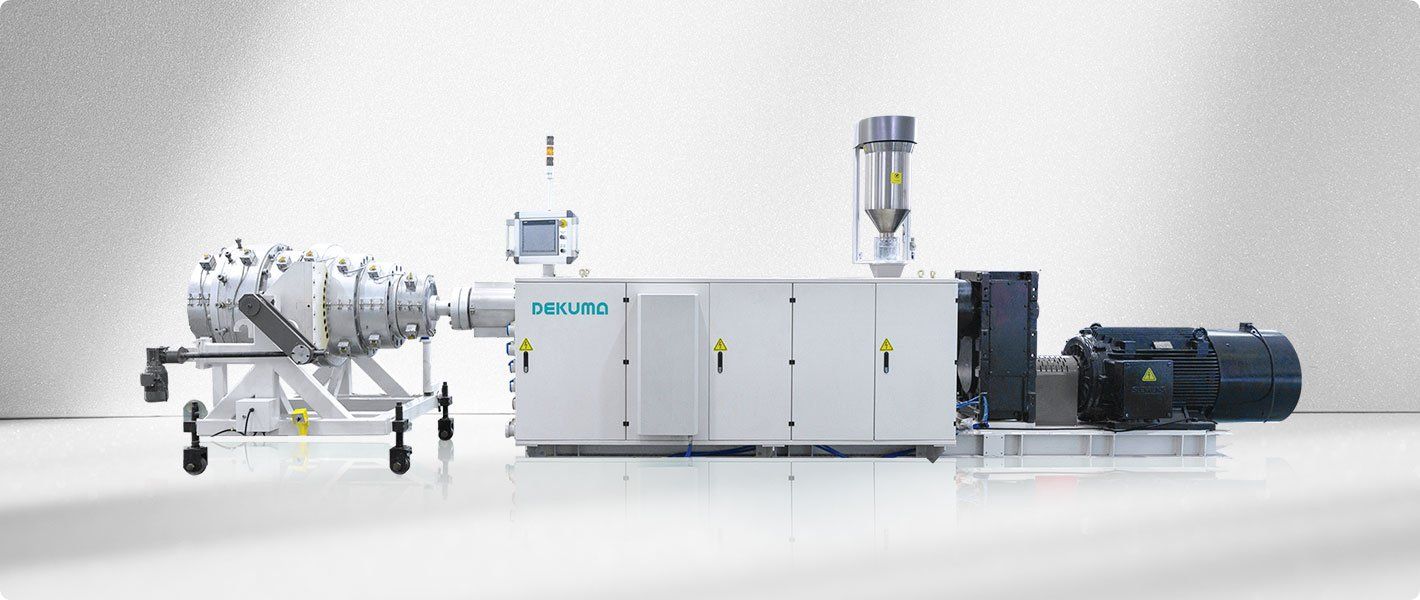
DEKUMA’s extrusion equipment portfolio includes single-screw systems with modular PLC control for automated operation and real-time process monitoring, as well as twin-screw configurations intended for different material formulations. In an HDPE microduct application, the relevant equipment configuration should be assessed against the required throughput, resin characteristics, die design, and downstream sizing arrangement.
Calibration, Cooling, and Inline Verification
The dimensions formed at the die are not necessarily the final dimensions of the cooled duct. HDPE contracts as it cools, and uneven heat removal can introduce dimensional changes or residual stress. Vacuum calibration and controlled cooling help establish the outside profile, while water temperature, vacuum level, line alignment, and haul-off tension all affect the stability of the tube during sizing.
The internal bore requires particular attention because it cannot always be inspected as easily as the external surface. Excessive drawdown, uneven cooling, or inconsistent wall formation may reduce the passage available for fiber installation even when the outside diameter appears acceptable. A pipe extrusion machine should be evaluated alongside its calibration and cooling equipment, with measurement methods selected to verify both external dimensions and internal geometry.
Inline diameter measurement can track outside-diameter variation continuously, while dedicated bore inspection or suitable offline gauges can confirm internal dimensions. Sampling frequency should reflect the production speed and the consequences of dimensional drift.
Conclusion
Consistent HDPE microduct production above 80 m/min depends on controlling several interacting variables, not simply increasing screw speed. Stable melt pressure supports predictable flow, gravimetric dosing links material consumption to line speed, and well-designed tooling establishes uniform circumferential distribution. Calibration, cooling, and dimensional verification then determine whether that geometry survives the journey from molten polymer to finished duct.
For telecom manufacturers evaluating a plastic extruder, the practical benchmark is sustained bore consistency under real production conditions. DEKUMA offers extrusion technology and automated monitoring capabilities that can be assessed against those requirements, with final equipment selection guided by resin trials, target dimensions, and measured production results.
